
Summary:
The ads make it sound simple. Pay $50, watch some videos, get certified, start bartending. Online bartending certification programs promise you can learn everything from your couch in a weekend. And if you’re trying to break into bartending in Nassau County without spending a fortune or taking weeks off work, that sounds pretty good.
But here’s the question nobody’s answering clearly: do these online certifications actually get you hired? More importantly, do they prepare you to succeed once you’re behind the bar during a Friday night rush? Let’s look at what online bartending certification really offers, what it leaves out, and what employers in Nassau and Suffolk Counties are actually looking for when they’re hiring.
What You Actually Learn from Online Bartending Certification
Online bartending certification programs teach you drink recipes. That’s not a criticism—it’s just what the format allows. You’ll watch videos demonstrating how to make a Manhattan, a Mojito, and a Long Island Iced Tea. You’ll take quizzes on liquor types and glassware. You’ll learn the difference between shaking and stirring.
This knowledge has value. Knowing 50 or 100 cocktail recipes before your first shift means you’re not starting from zero. Understanding that a martini goes in a specific glass and a margarita requires specific ingredients gives you a foundation.
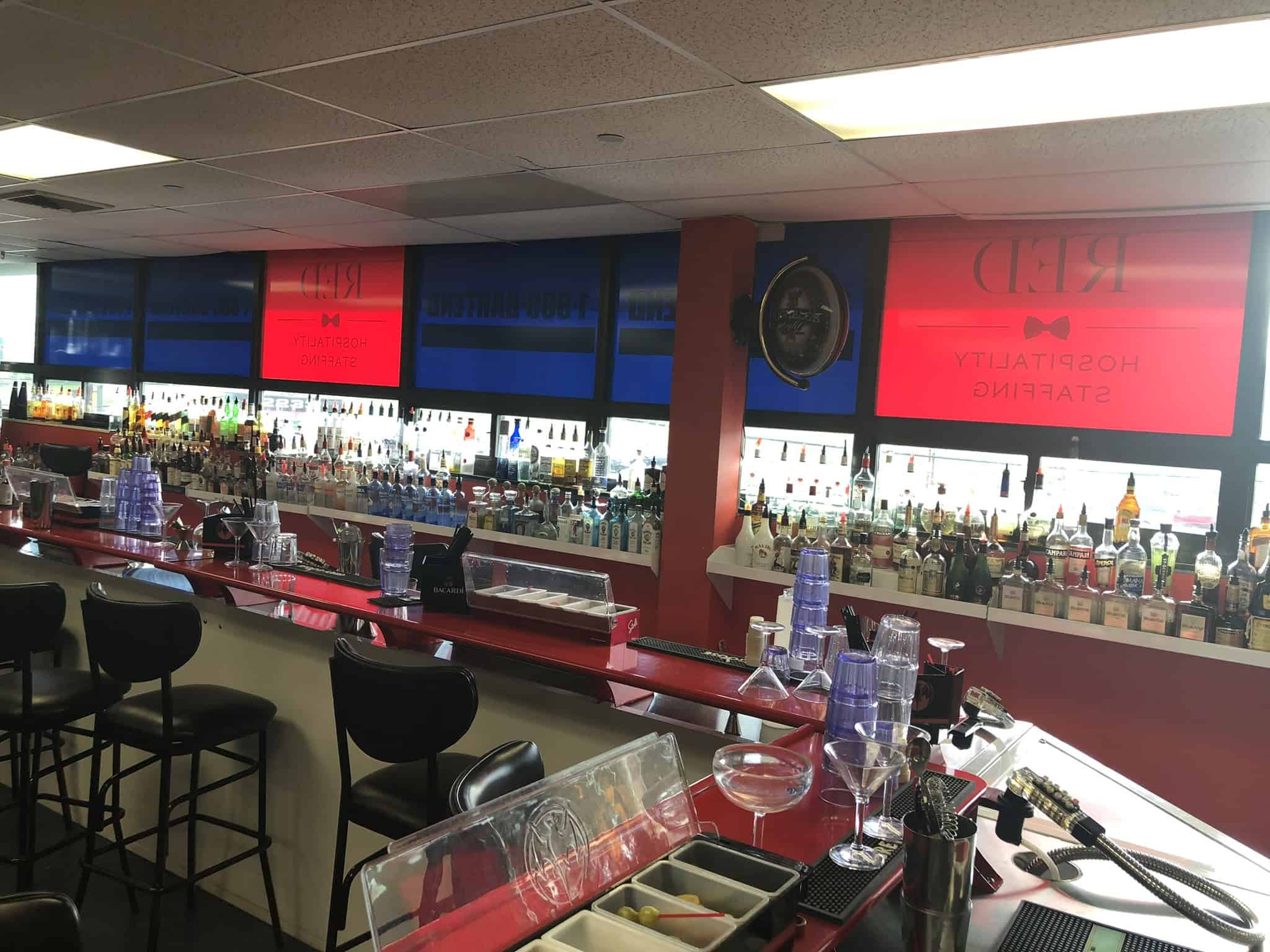
But here’s what online programs can’t teach you: speed, multitasking, muscle memory, spatial awareness behind a bar, or how to handle five drink orders simultaneously while a customer is asking you a question and your coworker needs you to grab something from the lower shelf. You can’t learn to free-pour accurately by watching someone else do it on a screen. You can’t develop the rhythm of a busy bar by taking an online quiz. That’s why a hands-on mixology class offers something no screen-based program can replicate.

The Skills Gap Between Online Certification and Real Bar Work
Talk to any bar manager in Nassau County and they’ll tell you the same thing: the bartenders who struggle most are the ones who show up with recipe knowledge but zero practical experience. They know what goes in a Cosmopolitan, but they’ve never actually made one under pressure.
Bartending is a physical job. You’re on your feet for hours. You’re reaching, pouring, shaking, straining, garnishing—often doing three of those things at once. Your hands need to know where everything is without looking. Your body needs to move efficiently in a small space, often with other people working right next to you.
Online bartending certification programs can’t replicate this. You’re not learning how to use a soda gun or how to quickly locate bottles in a well. You’re not practicing making four different drinks simultaneously while keeping track of which goes to which customer. You’re not building the stamina to work a six-hour shift without your back giving out.
Industry experts with over 30 years of training experience put it bluntly: “There is no way you can learn to bartend online. Plain and simple, this is a very hands-on job and it must be learned that way.” It’s like learning to drive a car—you can study the manual all you want, but you’re not ready for the road until you’ve actually been behind the wheel.
Speed is another critical factor that online programs completely miss. Anyone can make a drink following a recipe if they have unlimited time. But can you make it accurately in under 60 seconds? Can you make five drinks in three minutes? That’s what employers need, especially during peak hours, and it’s a skill that only comes from repetitive practice with real equipment.
What Online Bartending Certification Does Well
Let’s be fair about what online bartending certification actually offers. If you’re already working in a bar—maybe as a server or barback—and you just need to learn the drink recipes and theory, an online program can fill that gap affordably. You’ve got the practical experience; you just need the knowledge component.
Online courses also work if you’re looking to bartend casually for private events or small gatherings, not as a professional career. Learning how to make a dozen popular cocktails for your own entertainment or to help out at a friend’s party? An online course at $50-$200 makes sense for that purpose.
The flexibility is real too. Online bartending certification lets you study at 11 PM after the kids are asleep or during your lunch break. There’s no commute, no fixed schedule, no need to coordinate with class times. For people with demanding work schedules or family obligations, that convenience matters.
Some online programs also include responsible alcohol service training—the legal component covering how to check IDs, recognize intoxication, and serve alcohol safely. In New York, this is the ATAP certification, and some online courses do provide legitimate training in this area. That’s valuable regardless of how you learn the practical bartending skills.
But here’s where online certification falls short for most people: if you’re trying to get hired at an actual bar or restaurant in Nassau County, Suffolk County, or Queens, employers aren’t just looking for someone who knows recipes. They’re looking for someone who can work efficiently, handle pressure, and contribute to a team without needing weeks of on-the-job training to catch up.
Why Nassau County Employers Prefer Hands-On Training
Nassau County’s bar and restaurant scene is competitive. You’ve got everything from casual neighborhood spots to upscale establishments in Roslyn and Garden City. The proximity to New York City means customer expectations are high, and employers need bartenders who can deliver quality service immediately.
When hiring managers review applications, they’re looking for candidates who can start contributing from day one. That means someone who’s comfortable behind a bar, knows how to move efficiently, and doesn’t need hand-holding during the first busy shift. Hands-on training programs signal that you’ve actually practiced these skills, not just watched videos about them.
The networking factor matters too. Seventy percent of employers prefer word-of-mouth hiring over job websites. When you attend an established in-person bartending school, you’re connecting with an institution that has relationships with local bars and restaurants. Those connections often lead directly to job opportunities that never get posted publicly.

The Real Cost Comparison: Online vs In-Person Bartending Training
Online bartending certification typically costs $50-$200. In-person programs run $400-$800. At first glance, online looks like the smart financial choice. But you need to factor in what happens after you complete the program.
If you finish an online course and then spend two months applying to jobs without getting hired because employers want someone with practical experience, you’ve lost two months of potential income. Bartenders in Nassau County average $200 per day in tips on top of their base wage. Over two months, that’s potentially $12,000 in lost earnings while you’re still searching.
Now compare that to an in-person program. Yes, you’re paying $400-$800 upfront. But you’re also getting hands-on practice with real bar equipment, speed training, and direct connections to employers who are actively hiring. Many in-person schools have job placement assistance and relationships with local establishments. You could be working within a week of graduation.
The return on investment calculation isn’t just about the course cost—it’s about how quickly you start earning. A five-day intensive program that costs $600 but gets you hired immediately is a better financial decision than a $100 online course that leaves you underqualified and unemployed for months.
There’s also the lifetime value to consider. In-person programs often include lifetime refresher courses, meaning you can come back anytime to sharpen your skills or learn new techniques at no additional cost. That ongoing support has real value as you build your career and want to stay competitive.
What Employers Actually Ask For in Nassau County
Look at actual bartending job postings in Nassau County and you’ll notice a pattern. Many list “previous bartending experience” or “bartending school graduate” as preferred qualifications. Some specifically mention ATAP certification for New York State compliance. Very few mention online certification as acceptable.
Employers want to know you can handle the physical demands of the job. Can you work a six-hour shift on your feet? Can you lift kegs and cases of liquor? Can you multitask during a rush when there are twenty people waiting for drinks? These aren’t skills you can demonstrate from an online certificate.
They’re also looking for people who understand the business side of bartending—cash handling, inventory management, point-of-sale systems. In-person programs typically cover these topics with actual practice. You’re using a real cash register, learning to count a drawer, practicing how to track inventory. Online programs might mention these topics, but you’re not getting the muscle memory that comes from doing it repeatedly.
The ATAP certification is non-negotiable for many Nassau County employers. This is New York State’s Alcohol Training and Awareness Program, designed to ensure bartenders understand responsible alcohol service and state laws. While you can complete ATAP training online, pairing it with comprehensive in-person bartending training shows employers you’re serious about the profession.
Reliability matters more than recipe knowledge. Employers in Nassau and Suffolk Counties consistently say they’d rather hire someone with strong work ethic and hands-on training than someone who memorized 200 cocktails but has never worked a real shift. They can teach you their specific drink menu; they can’t teach you how to show up on time, handle stress, and work as part of a team.
Is Online Bartending Certification Worth It for Your Situation
Online bartending certification isn’t worthless—it’s just limited. If you’re already working in a bar and need to learn drink recipes, it’s a cost-effective option. If you’re bartending casually for private events, it gives you enough knowledge to get started. If you just need the ATAP certification for legal compliance, online training can handle that.
But if you’re trying to launch a real bartending career in Nassau County, online certification alone won’t get you there. Employers want candidates with hands-on experience, practical skills, and the confidence that comes from actually working behind a bar. The investment in comprehensive in-person training pays for itself quickly when you’re earning $200+ per day in tips instead of still searching for your first job.
The bartending industry in Nassau and Suffolk Counties is thriving, with hundreds of job openings and strong earning potential for qualified candidates. The question isn’t whether bartending is worth pursuing—it’s whether you’re preparing yourself in a way that actually leads to employment. For most people, that means choosing training that includes real equipment, practical experience, and direct connections to employers who are hiring. If you’re ready to invest in training that actually prepares you for the job, we offer the hands-on approach that gets you working, not just certified.