
Summary:
If you’ve been searching “bartending license near me” and hitting a wall of confusing results, you’re not alone. Most people assume New York issues some kind of official bartender license, like a driver’s license, but for pouring drinks. It doesn’t. What employers across Nassau County, Suffolk County, and Queens are looking for is something called ATAP certification, the Alcohol Training Awareness Program administered through the New York State Liquor Authority. Once you understand that distinction, the whole process becomes straightforward. Here is what it means, what it takes, and how you can get certified and working behind a bar faster than you probably think.
What Is A Bartending License In New York And Do You Need One?
New York State does not issue a bartending license. There is no DMV-style credential, no state exam you register for independently, and no government office handing out bartender cards. When someone tells you to “get your bartending license,” what they almost always mean is ATAP certification, the Alcohol Training Awareness Program administered through the New York State Liquor Authority.
ATAP is what signals to employers that you understand responsible alcohol service, New York’s liquor laws, and how to handle situations involving intoxicated or underage customers. It is valid for three years from the date you complete it, and the passing score on the exam is 70%. While New York doesn’t legally require it as a condition of employment, most serious employers, especially in Nassau County, Suffolk County, and Queens, expect it.
Is Online ATAP Certification The Same As Going To Bartending School?
This is where a lot of people get tripped up. You can find online ATAP courses for less than fifteen dollars, and technically, they do produce a valid certification. So it is fair to ask why anyone would bother with a full bartending program.
The honest answer is that ATAP certification and bartending training are two different things that happen to come bundled together at a quality school. The certification tells an employer you know the law. The training tells them you can do the job.
Think about what a real bar shift looks like: you’re managing multiple drink orders at once, working a soda gun, handling a cash register, keeping glassware organized under pressure, and staying sharp with customers who may have had one too many. None of that is covered in an online quiz. Employers in high-volume markets like Astoria, Long Island City, the Hamptons, and the waterfront spots along the Nassau south shore aren’t just checking for a certificate. They are looking for someone who can step behind the bar and function on night one.
There is also a practical job placement dimension. A cheap online course doesn’t come with a career network, an employer database, or anyone making calls on your behalf. That gap matters a lot when you’re trying to break into the industry without prior experience.
The bartending market in Nassau County alone currently lists over 350 open positions spanning casual dining, upscale cocktail lounges, sports bars, wedding venues, and craft cocktail establishments. Getting certified is step one. Being prepared to fill one of those roles is step two. Those are not the same step.
What Are The NYS Bartending License Requirements You Need To Meet?
Let’s lay it out plainly. To work as a bartender in New York, you need to be at least 18 years old. That is the legal minimum age to serve alcohol in the state. Beyond that, the core credential employers want is ATAP certification from an NYSLA-approved provider, not just any online course, but one that meets the state’s curriculum requirements. That distinction matters because only certifications from approved providers carry weight when it comes to potential liability reduction for the establishment.
A full bartending program from a reputable school will bundle several things together: ATAP certification, training in New York’s Alcohol Beverage Control Law, and in some cases B.A.R. training (Beverage Alcohol Resource training), which goes deeper into responsible service practices. When all three are included in a single program, you’re walking out with a genuinely comprehensive credential, not just a quiz score.
The ATAP exam itself covers four main areas: identifying signs of intoxication, refusing service appropriately, preventing sales to underage customers, and understanding the legal responsibilities that come with serving alcohol in New York. It isn’t designed to be a trick; it is designed to make sure you understand the real-world situations you’ll face behind a bar.
For Long Island residents in Huntington, Babylon, Valley Stream, and along the Suffolk and Nassau south shore, the commute question matters. The majority of well-regarded bartending schools with strong employer relationships are located in Manhattan. That is a real deterrent when you’re balancing work, family, and training commitments. The same goes for Queens residents in Jackson Heights, Flushing, or Jamaica, as a Manhattan commute for a week of classes adds friction that most people don’t need. Knowing that local options exist changes the calculus entirely.
How To Get Your Bartending Certification On Long Island Or In Queens
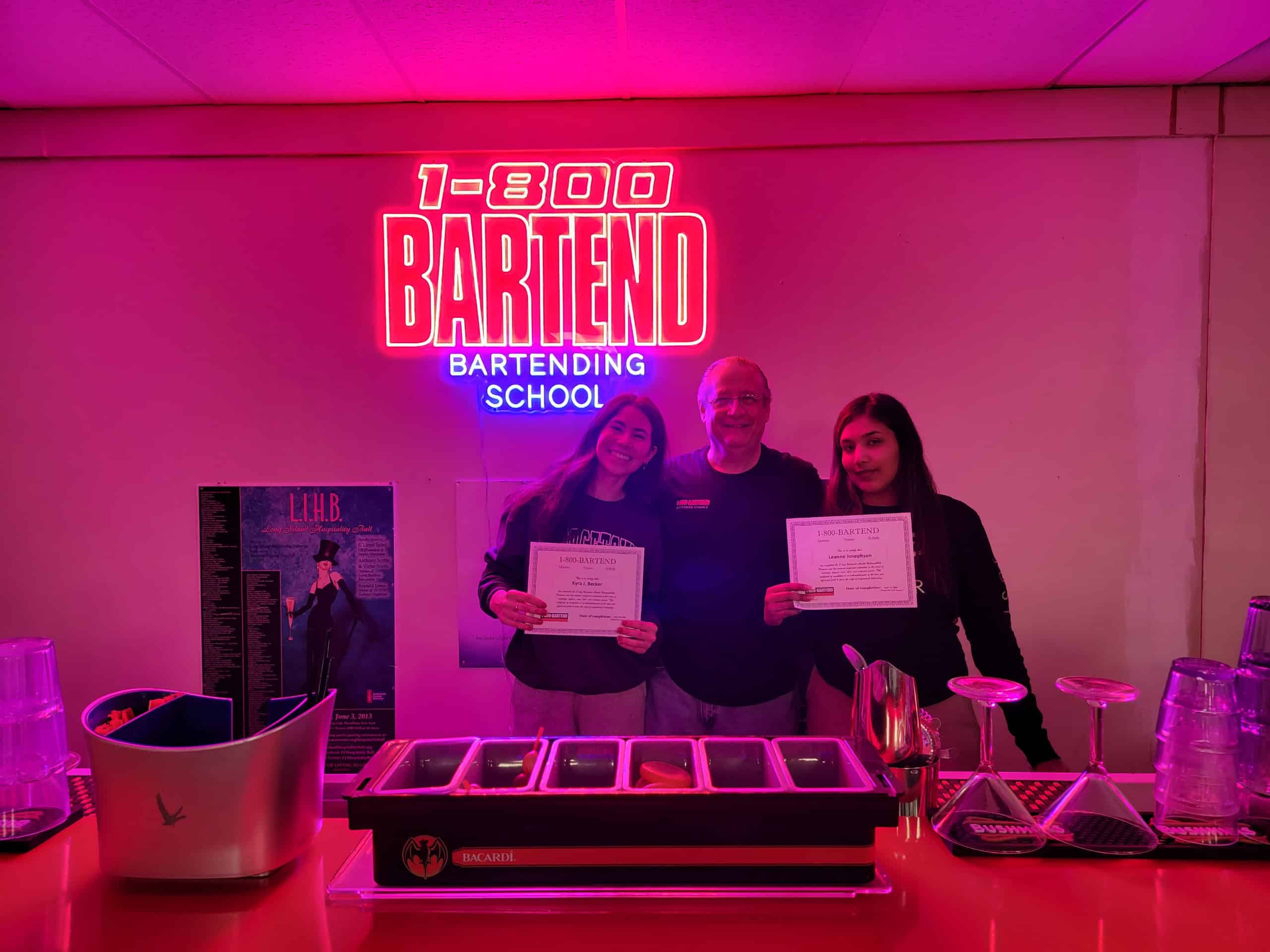
At 1-800 Bartend, we run two physical campuses: one in Farmingdale on NY-110, accessible from the Long Island Expressway, the Southern State Parkway, and the Northern State Parkway, and one in Jackson Heights at 84-02 Roosevelt Avenue, right on the 7 train line. Both locations are built around real bar setups with actual soda guns, glassware, and cash registers, rather than a classroom with diagrams.
We’ve been operating for over 30 years. That is not a detail we throw out for effect; it is the reason our employer network is as deep as it is, and why local hiring managers in Nassau County, Suffolk County, and Queens already know our graduates before they walk in the door.
What Does The Bartending Program At 1-800 Bartend Include?
Our signature program runs five days. By the end of it, you’ll have completed hands-on bar training, received your NY State ATAP certification, covered Alcohol Beverage Control Law, and completed B.A.R. training, all in one week. That is three credentials bundled into a single program, which is not the norm across the industry.
The training itself is built around doing, not watching. From day one, you’re behind a real bar, practicing the physical mechanics of the job: building drinks, managing glassware, working the register, and developing the kind of muscle memory that only comes from repetition. Instructors bring real industry experience into the room, not just a curriculum binder.
For students who can’t commit to five consecutive days, we also offer a condensed one-day option that still includes interactive instruction and certification. It is a good fit for people who already have some hospitality background and are primarily looking to formalize their credentials.
Once you graduate from the full five-day program, you get lifetime refresher courses at no additional charge. That is not something most schools offer, and it reflects a straightforward reality: the bar industry evolves, trends shift, and having a place to sharpen your skills years down the line has real value.
We also give graduates access to a 24/7 alumni job portal with current openings, along with active career support from a team that maintains direct relationships with employers who request our graduates. This isn’t a list of job board links; it is a functioning placement network built over three decades of operating in this market.
How Much Do Bartenders Make In New York And Is This Worth It?
It is a fair question, and the numbers are worth knowing before you decide. According to data from multiple salary sources, bartenders in the New York City metro area earn an average of around $200 per day in tips alone. Total compensation for full-time bartenders, which includes base wage plus tips, can reach approximately $46 per hour, with annual earnings for full-time workers in high-volume venues reaching into the $90,000 range. The top earners in the market clear over $100,000 a year.
For Long Island specifically, the earning potential is tied closely to the seasonal economy. The Hamptons represent one of the most lucrative summer bartending markets on the entire East Coast. Fire Island, Jones Beach, and the Long Beach corridor all generate significant demand from Memorial Day through Labor Day. Catering halls and country clubs across Nassau County and Suffolk County drive a secondary surge during wedding season, which runs May through October. If you complete a five-day program in the spring, you’re positioned to enter the market at the right moment.
Queens operates on a different rhythm, remaining year-round and driven by the density of restaurants and bars in neighborhoods like Astoria, Long Island City, and Jackson Heights. The hospitality job market there doesn’t have an off-season the way the Hamptons does, which makes it a strong option for anyone looking for steady, consistent work rather than seasonal peaks.
The broader point is this: bartending in New York is not a backup plan career. It is a skilled trade with real income potential, and the barrier to entry, consisting of a week of serious training and a certification exam, is low compared to what you can earn on the other side of it. The question is how quickly you want to get started.
Ready To Get Your Bartending Certification Near You In Nassau County, Suffolk County & Queens?
Here is the short version: New York doesn’t issue a bartending license, but ATAP certification from an approved provider is what employers want, and a full bartending program gives you that credential alongside the real skills to back it up. The process is faster than most people expect, and the earning potential on the other side is significant.
If you are in Suffolk County, Nassau County, or Queens, you don’t need to commute to Manhattan to get quality training. We have campuses in Farmingdale and Jackson Heights, a 30-year track record in this market, and a placement network that connects our graduates with local employers who already trust what we do.
Call 1-800 Bartend today or visit our website to sign up for classes and take the first step toward your new career!