Summary:
If you’ve been searching for bartending classes in Suffolk County, NY, you’ve probably already noticed that the options look pretty different from one another. Some schools are online-only, some come to your home, and a few don’t mention anything about state certification at all. That makes it hard to know what you’re getting.
The good news is that the path to becoming a working bartender in New York is straightforward once you understand what employers require. This post covers what the training looks like, what certifications matter, and what makes the difference between a program that gets you hired and one that just gets you a piece of paper.
What Bartending Classes In Suffolk County, NY Cover
Most people searching for bartending classes in Suffolk County, NY are looking for one thing: a fast, legitimate path to a real job, rather than a hobby course or a one-night mixology experience. You need a program that teaches you what you need to know and gives you the credentials that hold up when a hiring manager asks to see them.
A serious bartending course covers far more than drink recipes. You’re learning how to work behind a real bar: soda guns, commercial glassware, cash register operation, customer service, and the legal side of serving alcohol in New York State. That last part matters more than most people expect when they first sign up.

What Is ATAP Certification And Why Do Suffolk County, NY Employers Require It?
Here is something that trips up a lot of people: New York State does not require bartenders to hold a specific license to pour drinks. There’s no state-issued bartending license you need to apply for. What employers require, almost universally, is ATAP certification. That stands for Alcohol Training Awareness Program, and it’s issued through providers approved by the New York State Liquor Authority.
The reason employers insist on it isn’t just formality. Under New York ABC Law (specifically sections 65.6 and 65.7), a valid ATAP certificate can serve as an affirmative defense if an employee is ever involved in a liquor law violation. That’s a real legal protection for the business, and it’s why their insurance carriers often require it as a condition of coverage. If you walk into a bartending interview without it, you’re starting the conversation at a disadvantage.
ATAP certification is valid for three years from the date of issuance, after which it needs to be renewed. It’s not a lifetime credential, but it’s also not difficult to maintain.
At 1-800 Bartend, ATAP certification is included in every program we offer. You’re not paying extra for it, and you’re not getting a generic certificate that employers don’t recognize. We’re an NYSLA-approved provider, which means the credential you leave with is the one that satisfies both the legal standard and the employer requirement. We also include Alcohol Beverage Control Law training and B.A.R. certification in our curriculum, creating a credential stack that puts you ahead of candidates who only completed a basic online course.
For anyone looking at bartending classes in Suffolk County, NY specifically, this distinction matters. The South Shore beach bars, the Hamptons venues, and the North Fork wineries are serious hospitality operations. They check credentials. A program that skips over the legal compliance side isn’t preparing you for those jobs.
How Long Does A Bartending Course In Suffolk County, NY Take?
This is one of the most common questions we hear, and the honest answer depends on which program you choose. Our signature program is a five-day, full-time immersive course. You come in, you work behind a real bar, and you leave at the end of the week certified and ready to apply for jobs. That’s not a marketing claim; it’s the structure of the program, and it’s been working for over 30 years.
For people who genuinely can’t commit to five consecutive days, we also offer a condensed one-day option. It’s not the same depth of experience, but it includes interactive instruction and certification for students who need a faster path for scheduling reasons.
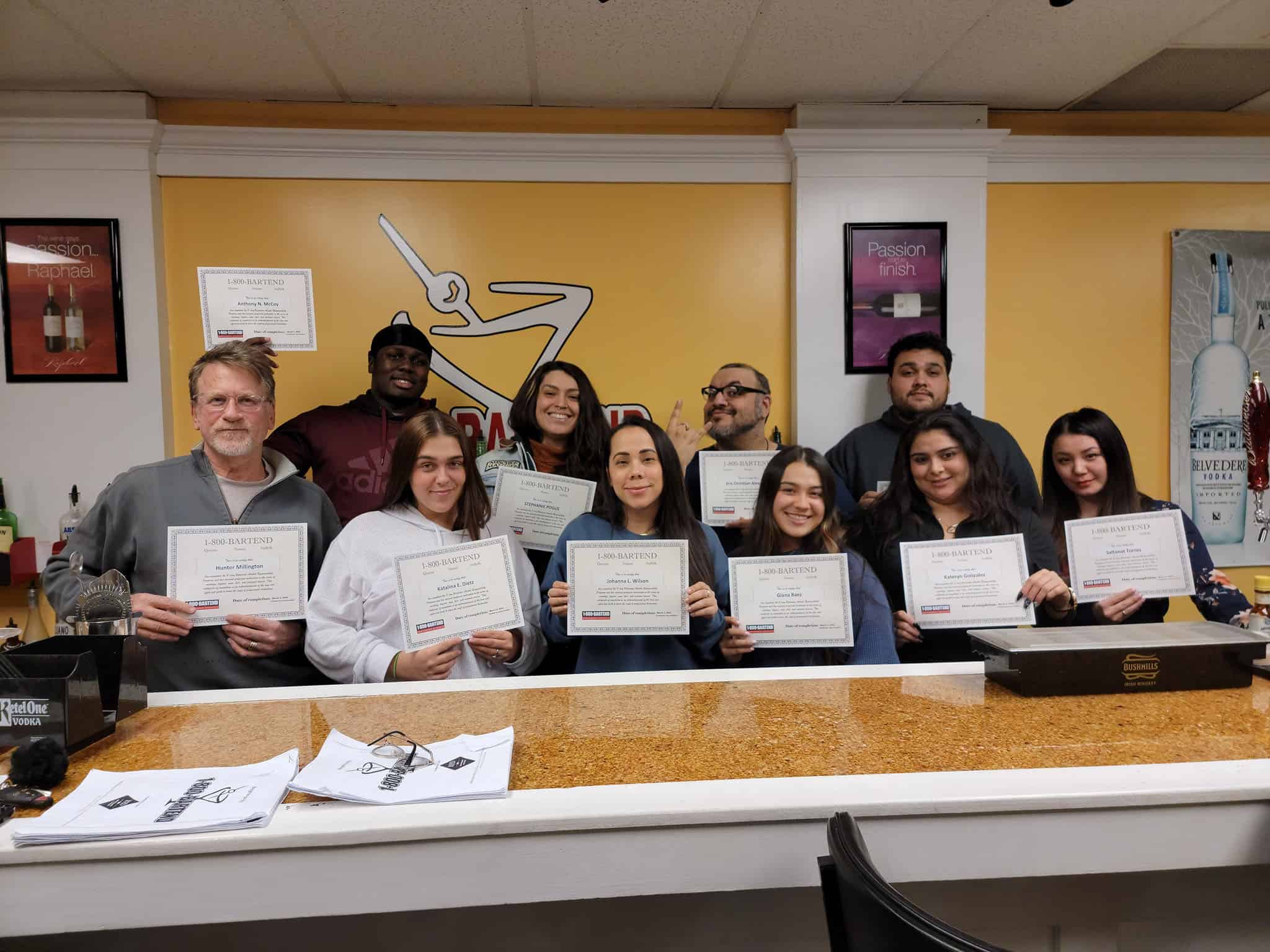
The five-day program is the one we recommend if your goal is to walk into interviews with real confidence. There’s a significant difference between someone who completed a week of hands-on training with real equipment and someone who watched videos at home. Bartending is a physical skill. Speed, flow, and muscle memory develop through practice, not reading. Our training uses actual soda guns, commercial glassware, and cash registers because that’s what you’ll be using on your first shift. Getting comfortable with that equipment before you’re standing in front of a full bar on a Friday night matters.
We also offer lifetime refresher courses for our graduates. If you take a break from bartending and want to shake off the rust before starting somewhere new, you can come back and practice at no additional cost. That’s one of the reasons our alumni network stays active long after graduation.
One more thing worth mentioning: the timeline question often comes up alongside the seasonal hiring cycle on Long Island. If you’re thinking about working the South Shore this summer, including Babylon, Bay Shore, Islip, and the Fire Island ferry towns, the window to train and get hired before Memorial Day is real. Bars in those areas start filling their seasonal rosters in April and May. Starting your training in late winter or early spring puts you in the right position to be one of the first certified candidates in front of those hiring managers.
Where To Take Bartending Classes Near Suffolk County, NY
One of the most practical questions for Suffolk County, NY residents is simply where to go. A lot of people assume that getting serious bartending training means making the trip into New York City. It doesn’t.
Our Long Island campus is located at 2233 NY-110 in Farmingdale, right at the Nassau and Suffolk border. Route 110 is the main north-south corridor connecting Nassau and Suffolk counties, and it intersects directly with Sunrise Highway (Route 27) and the Long Island Expressway (I-495). For residents of western and central Suffolk County, NY, this is a straightforward drive. No city traffic, no subway transfers, and no added time.
Getting To Our Farmingdale Campus From Suffolk County, NY
If you’re coming from towns like Wyandanch, Deer Park, Babylon, West Islip, Amityville, or Lindenhurst, the Farmingdale campus is typically 10 to 20 minutes away depending on where you’re starting from. Sunrise Highway and Route 110 are the two main arteries, and both feed directly to the campus area.
For students without a car, the Farmingdale LIRR station on the Ronkonkoma Branch is nearby. That line connects through Nassau County and into Penn Station, which means Suffolk County, NY residents from Brentwood, Central Islip, and further east can reach the campus by train. It’s a realistic option for students who commute or don’t want to deal with parking in the city.
We also have a Queens campus at 84-02 Roosevelt Avenue in Jackson Heights. That location is served by the 7 train and several other subway and bus lines, making it highly accessible for students coming from Queens and the surrounding area. If you’re in eastern Queens or western Nassau and the Farmingdale campus is a longer drive than you’d like, Jackson Heights is worth considering.
The point is that neither campus requires you to go out of your way. We built our school to serve Long Island and Queens specifically, which is the market we’ve been working in for over 30 years, and our locations reflect that.
What Do Bartenders Earn In Suffolk County, NY And The NYC Metro Area?
Let’s talk numbers, because this is usually part of the decision. Bartending in the New York metro area pays well, and a meaningful portion of that income comes from tips rather than just the hourly rate.
According to recent industry data, bartenders in the NYC area have seen wages grow nearly 38% between 2020 and 2024, with employment up over 53% in the same period. Full-time bartenders in the metro area can bring in approximately $46 per hour when tips are factored in, which translates to roughly $96,000 annually for those working consistent full-time hours. Tips alone account for about 55% of total earnings in this market.
For Suffolk County, NY specifically, the earning potential varies significantly based on where you work. A sports bar in Babylon is going to look different from a beach club in Southampton or a tasting room on the North Fork. The Hamptons, including Southampton, East Hampton, and Montauk, are among the most lucrative bartending markets in the state during the summer season. Those venues draw high-spending crowds from Memorial Day through Labor Day, and experienced, certified bartenders who can handle volume and service expectations are in high demand.
Realistic tip expectations for a competent bartender at a decent venue run around $150 to $250 per shift, based on our own salary guide data. That number climbs at premium venues during peak season, and it drops at slower neighborhood spots. The credential and training quality you bring to the interview affect which tier of venues takes you seriously.
Beyond the seasonal peaks, Suffolk County, NY’s year-round hospitality market is substantial. Hundreds of restaurants, catering halls, and event venues across towns like Huntington, Smithtown, Patchogue, and Riverhead hire trained bartenders throughout the year. The summer season gets the attention, but the demand doesn’t disappear in October.
After graduation, our alumni have access to a 24/7 job portal that’s continuously updated with open positions. We also work directly with bar and restaurant operators on the consulting and hiring side, meaning some of the employers using our portal already know and trust our graduates before the interview even happens. That’s a different kind of job support than a generic online job board.
Ready To Start Your Bartending Career In Suffolk County, NY?
If you’ve been on the fence about bartending classes in Suffolk County, NY, the main things to weigh are pretty clear: Does the program include legitimate ATAP certification from an NYSLA-approved provider? Does it involve real hands-on training with actual bar equipment? And does the school have a track record of placing graduates with real employers?
Those three questions filter out most of the thin options in this market quickly.
We’ve been training bartenders on Long Island for over 30 years, and the Farmingdale campus exists specifically because this is the market we serve.
Call 1-800 Bartend today or visit our website to sign up for classes and take the first step toward your new career!