Summary:
You’ve decided you want to bartend. Maybe it’s the income, maybe it’s the flexibility, or maybe you’ve watched one too many Friday nights from the wrong side of the bar. Whatever got you here, you’re now staring at a list of bartending schools and trying to figure out which one is worth your time and money.
That’s exactly what this is for. This is not a sales pitch. It is a real breakdown of what to look for, what to ignore, and why the school you choose matters more than most people realize, especially if you are in Nassau County, Suffolk County, or Queens.
What To Look For In A Bartending School Near You
Most people searching for bartending classes near them focus on two things: price and location. Those matter, but they are not what determines if you get hired after graduation. The details that move the needle are the ones most schools bury in fine print or skip entirely.
The first thing worth asking is if the school includes New York State A.T.A.P. certification. In New York, this isn’t optional. Most employers in Nassau County, Suffolk County, and Queens use it as a first-pass filter when reviewing candidates. If a school doesn’t include it, or if they charge extra for it, that tells you something important about their priorities.
The second thing to consider is if you are training on real bar equipment or sitting through slideshows. There is a meaningful difference between watching someone make a drink and building the muscle memory yourself. Speed, efficiency, and confidence behind the bar come from repetition with real tools, not from a workbook.

Why New York's A.T.A.P. Certification Changes Your Chances Of Getting Hired
A.T.A.P. stands for Alcohol Training Awareness Program, and it is New York State’s official certification for responsible alcohol service. It covers how to identify intoxication, how to handle difficult situations, and the specifics of New York’s Alcohol Beverage Control Law, which is the legal framework that governs every bar and restaurant in the state.
Here is why it matters practically. When a bar manager in Freeport or a restaurant on Huntington’s New York Avenue is hiring, they are not just looking for someone who can make a gin and tonic. They are looking for someone who won’t create a liability problem. An uncertified bartender is a legal exposure they don’t want. A certified one is easier to hire, easier to insure, and easier to defend if something goes wrong.
Beyond A.T.A.P., stronger programs also include B.A.R. training (Beverage Alcohol Resource), which is a higher-level credential associated with craft cocktail programs and upscale bar environments. If you are aiming for the kind of work that pays well, this distinction matters. A bar in the Hamptons or a hotel lounge near JFK isn’t going to pay top dollar for someone whose training stopped at the basics.
The point isn’t to overwhelm you with acronyms. It is to help you understand that certification in New York isn’t a box to check. It is the credential that gets your résumé past the first round. When you are comparing schools, ask directly: is A.T.A.P. included, or is it an add-on? The answer tells you a lot about how seriously the school takes your outcome versus your enrollment.
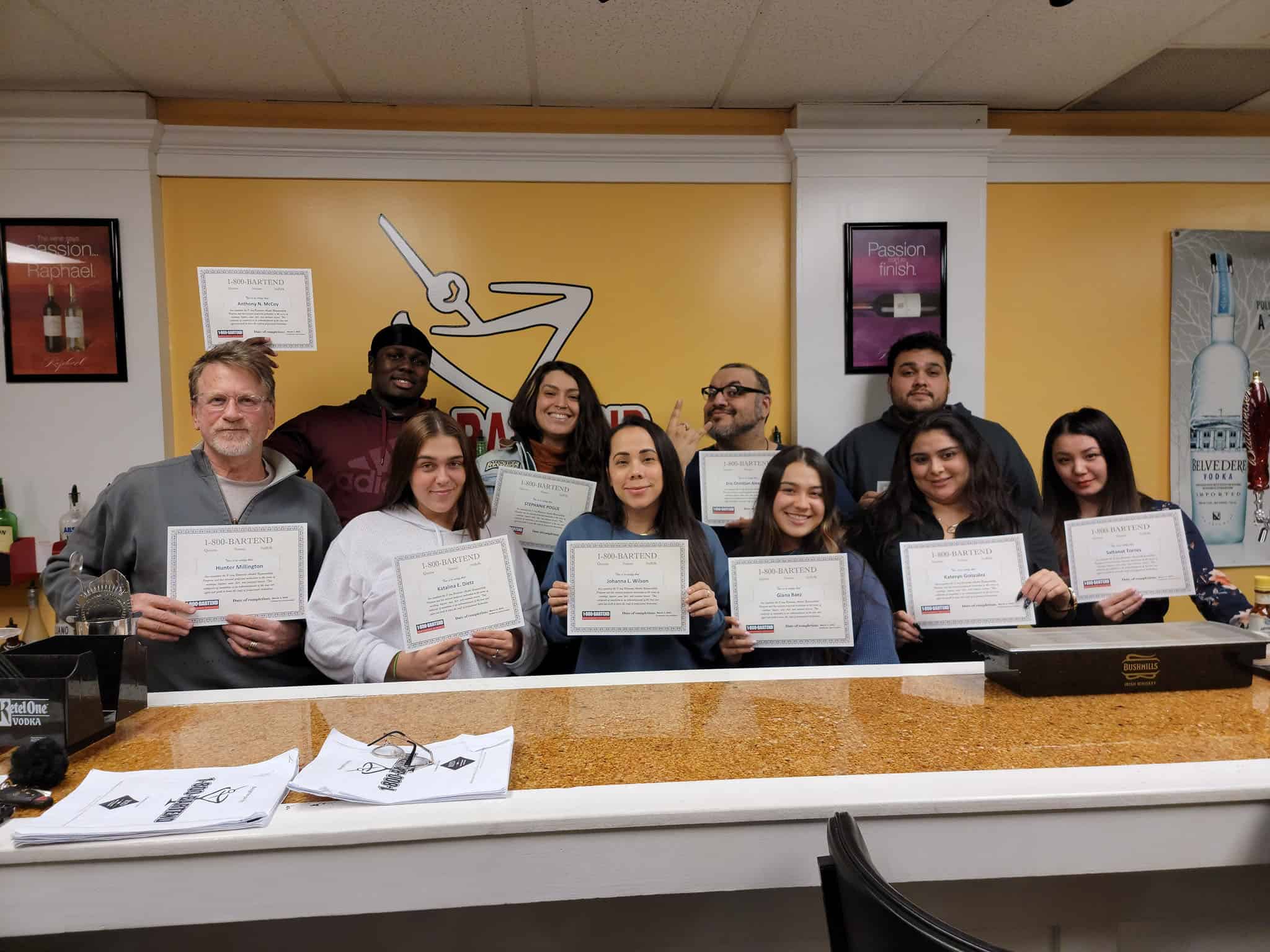
At 1-800 Bartend, A.T.A.P. certification is built into both our five-day and one-day programs. It isn’t an upsell. It is simply part of what you are there to earn.
Hands-On Training vs. Theory-Heavy Courses: Why The Difference Matters On Your First Shift
There is a version of bartending education that involves a lot of sitting, a lot of reading, and not much real bartending. You memorize drink recipes, pass a written test, and walk out with a certificate that doesn’t reflect what you can actually do under pressure on a Saturday night. That gap between classroom knowledge and real-world performance is exactly what gets new bartenders cut from their first job.
Hands-on training means something specific. It means you are behind a real bar, handling real equipment like soda guns, speed rails, glassware, and a cash register right from the first day. It isn’t a tabletop simulation, and it isn’t a demonstration you watch from a chair. You are making drinks, practicing sequences, and building the kind of physical confidence that shows up when a bar is three-deep and everyone wants something different.
This is why the training environment matters as much as the curriculum. A school that brings a portable kit to a rented conference room is a fundamentally different experience from a school with a permanent facility designed to replicate a working bar. When you graduate from the latter, your first shift doesn’t feel like your first shift.
Our Farmingdale campus on NY-110 and our Queens location at 84-02 Roosevelt Avenue in Jackson Heights are built for this. Students train on real bar setups from day one, not as a selling point, but because it is the only way to produce someone who is genuinely job-ready at the end of the week. Over 30 years of placing graduates in bars across Nassau County, Suffolk County, and Queens has made one thing clear: employers can tell the difference in the first hour of a working interview.
How Long Island's Job Market Should Shape Your School Decision
Choosing a bartending school isn’t just about the curriculum. It is about if the school understands the market you are trying to work in. Long Island’s hospitality economy has a rhythm that doesn’t apply anywhere else in the country, and if your school isn’t built around it, you are leaving money on the table.
The seasonal spike is real. From Memorial Day through Labor Day, the demand for trained bartenders across Suffolk County’s East End, including the Hamptons, Montauk, and Fire Island, is unlike anything you will find in most metro areas. These venues pay well precisely because the season is short and the volume is high. But they hire in advance, and they hire certified candidates first.
If you want to work that season, you need to be certified and job-ready before it starts. A school that can get you there in a week isn’t a shortcut. It is the practical choice.
What Bartenders Earn In Nassau County, Suffolk County, And Queens
The income question is usually the first one people have and the last one schools want to answer directly. So here it is plainly. Long Island bartenders average $19.79 per hour in base pay, plus roughly $200 per day in tips. On an eight-hour shift, that works out to around $280. On a busy Friday night in Nassau County, our graduates average $250 in tips alone.
When you factor in base pay and tips together, skilled bartenders in this market are regularly pulling $35 to $70 or more per hour, and on the right nights, tips alone can hit $200 to $300.
The Hamptons market sits at the top of that range. Southampton, East Hampton, Bridgehampton, and Montauk draw high-volume, high-spend crowds from late May through early September. A certified bartender working the East End during peak season can earn more in a single summer than many people make in six months at a salaried job.
Queens operates differently. The year-round hospitality economy there is anchored by Astoria’s dense restaurant scene, the growing bar culture in Long Island City, Flushing’s food halls, and the airport lounges at JFK and LaGuardia. This market doesn’t have an off-season. The earning potential is steadier and the demand is constant. For someone coming out of our Jackson Heights campus, the 7 train corridor connects you to virtually every major hospitality market in the borough within a reasonable commute.
The takeaway is that the income is real, but it is market-specific. A school that knows these markets, having spent 30 years placing graduates in Nassau County, Suffolk County, and Queens, is better positioned to connect you with the right opportunities than one operating out of a national template.
Does The School Help You Find Work After You Graduate?
This is the question most people forget to ask until it is too late. You graduate, you have your certificate, and then you realize the school’s idea of “career support” is a PDF list of job boards you could have found yourself on Google. That is not career support; it is just a handshake and a good luck.
What helps is an employer network that was built over time, not assembled to fill a webpage. When bars, restaurants, hotels, and event venues in Nassau County, Suffolk County, and Queens know a school’s graduates, that relationship has real value. If they have hired them before, seen them work, and come back for more, it means your résumé comes in with context instead of cold.
We have spent over three decades building those relationships on both sides of the equation. We work with employers directly by offering consulting and hiring assistance to businesses looking for trained staff. This means we are not just pointing graduates at job listings, but we are connected to the people doing the hiring. Employers in this tri-county area specifically request our graduates because they know what a 1-800 Bartend certification means in practice.
Beyond that network, our alumni have access to a 24/7 job portal that stays current with real opportunities, not just when the office is open. And if you graduate, start working, and find yourself wanting to sharpen something or refresh your skills down the line, our lifetime refresher courses are free. That is not a common offer in this industry, and it matters because bartending is a skill that compounds with practice. The option to come back and keep building is one fewer thing to worry about when you are just getting started.
When you are comparing schools, ask them directly: what happens after I graduate? The specificity of the answer will tell you everything.
How To Choose The Right Bartending School In Nassau County, Suffolk County, Or Queens
The right bartending school is the one that gets you certified, trained on real equipment, and connected to employers who are hiring in your market. In New York, that starts with A.T.A.P. certification, and it extends to if the school has the local relationships, the physical facilities, and the post-graduation support to back up what they promise in their marketing.
Long Island’s seasonal economy and Queens’ year-round hospitality demand are two very different environments, but both reward bartenders who show up prepared. A one-week program that covers certification, hands-on training, and career placement isn’t cutting corners. It is built for people who have real lives and real timelines.
We have campuses in Farmingdale and Jackson Heights, with a 30-year track record of placing graduates in bars across Nassau County, Suffolk County, and Queens.
Ready to get behind the bar? Call 1-800 Bartend today or visit our website to sign up for classes and take the first step toward a profitable new career. The conversation is free, and it is a great place to start!