
Summary:
You’ve looked at bartending as a career move. Maybe you’re tired of your current job, or you want something with better hours and cash in your pocket every night. But before you sign up for anything, you need to know what bartending school actually costs—and whether it’s a smart use of your money.
Here’s the reality: bartending school tuition in New York ranges from about $200 to $800, depending on what you’re getting. But price alone doesn’t tell you much. Some programs leave you with a certificate and no clue how to handle a Friday night rush. Others put you behind a real bar with real equipment and real skills that get you hired fast.
Let’s break down what you’re actually paying for, what to watch out for, and how to know if the investment makes sense.
Bartending Classes Cost: Complete New York Pricing Guide
When you start researching bartending classes cost in New York, you’ll see numbers all over the map. Some online courses advertise $20 to $100. Others charge $400, $600, even $800 for what looks like the same thing.
The difference comes down to what’s included and how you’re learning. Online courses are cheap because they’re videos and quizzes. You’re not touching bottles. You’re not using a soda gun or a POS system. You’re definitely not learning to make a drink under pressure while three people are waiting and your manager’s watching.
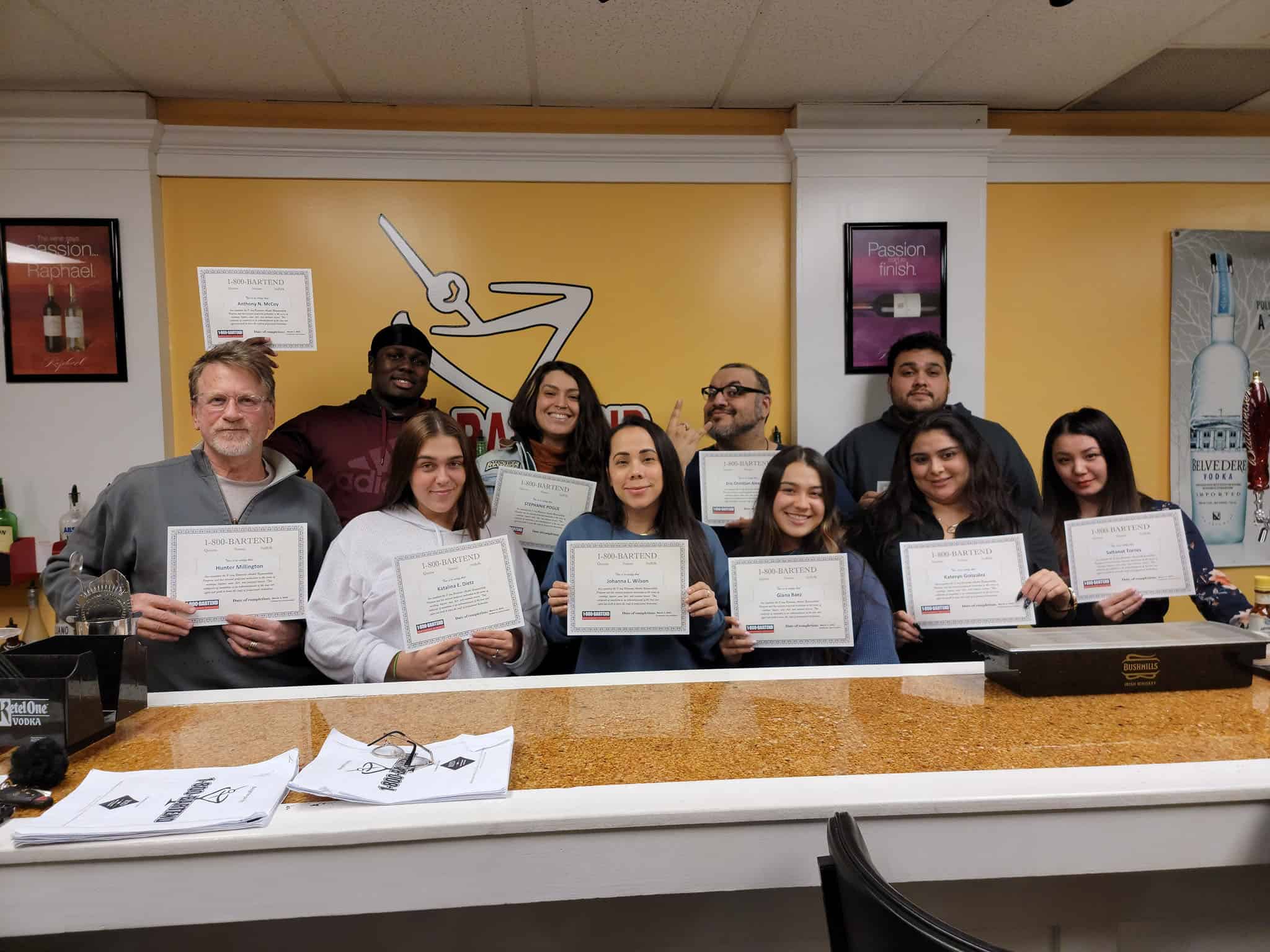
In-person programs cost more because they give you hands-on time. You’re standing behind an actual bar setup, mixing drinks, pouring accurately, running a register, and getting comfortable with the chaos before you ever step into a real shift. That’s what employers actually care about when they’re deciding whether to hire you.

Bartending Course Fees: What's Actually Included
Most bartending schools in New York advertise one price, but you need to know what that price covers. Some programs include everything. Others nickel-and-dime you with add-ons you didn’t see coming.
Here’s what should be included in your bartending course fees: the training itself (usually 20 to 40 hours of instruction), New York State ATAP certification, hands-on practice time with real bar equipment, a coursebook or recipe guide, and some form of job placement support. If a school charges extra for any of that, you’re getting upsold.
ATAP certification is the big one. New York doesn’t require a bartending license, but employers want proof you know how to serve alcohol responsibly. ATAP (Alcohol Training Awareness Program) is the state-approved certification that covers legal obligations, fake ID detection, and responsible service. You can get ATAP alone online for $10 to $40, but that won’t teach you how to bartend. It just covers the legal stuff.
The question is whether you want to pay $15 for a certificate that doesn’t get you hired, or invest in real training that includes ATAP plus the skills employers actually need. Most people who take the cheap route end up back at square one because they can’t land a job. Bar managers can tell in about thirty seconds if you’ve actually been behind a bar or just watched videos.
Good programs also include lifetime refresher courses. That means if you take six months off or want to brush up before applying somewhere new, you can come back and practice without paying again. Not every school offers this, so ask before you enroll.
Another thing to check: job placement assistance. Some schools just hand you a list of bars and wish you luck. Others have actual relationships with employers and a portal where jobs get posted daily. That’s the difference between scrambling on Craigslist and getting connected to real opportunities.
Hidden Fees and Additional Expenses to Expect
Even when a school advertises one price, there can be extras you didn’t plan for. Here’s what to watch out for so you’re not surprised later.
Some schools charge a separate registration fee on top of tuition. It might be $50 or $100 just to hold your spot. That’s not always a red flag, but you should know about it upfront. Ask if the price you’re quoted is the total cost or if there are additional fees.
Textbooks or coursebooks are sometimes extra. A few schools include them, others charge $30 to $50 for the materials. If you’re comparing two programs and one seems cheaper, check if they’re bundling the book or charging separately.
Retake fees can add up if you don’t pass the first time. Most bartending schools have a final exam, and if you don’t pass, some charge $20 to $50 to retake it. Other schools let you retake it for free. Again, ask before you sign up.
Then there’s the stuff schools don’t mention because it’s technically not their cost. You might need to budget for transportation to and from class, especially if you’re commuting to Long Island or Queens for training. If the program runs during the day and you’re currently working, you’re also losing income for that week. That’s an opportunity cost, not a fee, but it’s real money you need to account for.
One expense that’s worth it: proper bar tools if you want to practice at home. A basic shaker, jigger, and strainer might run you $30 to $50, but that’s optional. Most schools provide everything you need during training.
The smart move is to ask for a full breakdown in writing before you pay anything. If a school won’t give you a clear answer about total cost, that’s a warning sign.
Bartending School Tuition vs ATAP Certification: What's the Difference
This is where a lot of people get confused. You can get New York ATAP certification online for $10 to $40 and be done in a few hours. So why would anyone pay $400 or $600 for bartending school?
Because ATAP certification alone doesn’t teach you how to bartend. It teaches you the legal side—how to check IDs, what happens if you serve a minor, how to recognize someone who’s had too much. That’s important, and employers want it, but it won’t get you hired if you don’t know how to make a drink or work a busy shift.
Bartending school tuition covers the full skillset. You’re learning drink recipes, pouring techniques, how to use a soda gun and a POS system, how to manage inventory, how to upsell without being pushy, and how to handle difficult customers. You’re also getting ATAP certification as part of the program, so you’re not paying for it twice.
Is Bartending School Worth It or Should You Just Get ATAP
If your only goal is to check a box so an employer will consider you, ATAP alone might be enough—if you already have bar experience or you’re willing to start as a barback and work your way up. But if you want to walk into an interview with actual skills and confidence, bartending school is the faster route.
Here’s the math. Let’s say you pay $15 for ATAP certification and apply to 20 bars. You might get a barback position making $15 an hour with no tips, and it could take six months to a year before they let you behind the bar. Or you pay $400 for bartending school, get hired as a bartender in two weeks, and start making $20 to $30 an hour with tips. In Nassau County, NY, bartenders earn a base of $10.65 to $15.50 per hour, but tips add another $100 to $400 per night depending on the venue.
Do the ROI calculation. If you’re making an extra $200 a night in tips, you’ve covered your $400 tuition in two shifts. Even if it takes you a month to land the job, you’re still way ahead of the person who saved money on training but spent six months as a barback.
The other factor is confidence. Walking into an interview after a week of hands-on training is completely different from walking in with just a certificate. You know you can handle the job because you’ve already done it in a training environment. That shows, and managers pick up on it immediately.
There’s also the issue of what kind of bars will hire you. High-volume spots, upscale lounges, and places with serious money in tips usually won’t even look at someone without real training. They need people who can step in and perform from day one. If you’re aiming for those jobs, bartending school isn’t optional—it’s the entry point.
ROI Analysis: Training Investment vs Earning Potential
Let’s talk about whether bartending school actually pays for itself, because that’s what really matters. You’re not spending money on education for fun. You’re doing it to make more money faster.
The average bartending school tuition in New York is around $400 to $600 for a comprehensive program. Let’s use $500 as the baseline. In Nassau County, NY, bartenders make about $10.65 to $15.50 per hour base pay, plus tips. On a decent night, you’re looking at $100 to $200 in tips. On a great night—weekends, events, busy seasons—you could clear $300 to $400 in tips alone.
If you’re working three shifts a week and averaging $150 in tips per shift, that’s $450 a week in tips, or about $1,800 a month. Your base pay adds another $1,200 to $1,800 a month depending on your hourly rate and how many hours you’re getting. So you’re looking at $3,000 to $3,600 a month total, and that’s conservative.
At that rate, your $500 training investment is covered in your first two weeks of work. Everything after that is profit. Compare that to a four-year college degree that costs $40,000 to $100,000 and takes years to pay off, and bartending school starts to look pretty smart.
The other side of ROI is time. Most bartending programs in New York run one to two weeks. Some offer intensive one-week programs where you’re in class five days and certified by Friday. Others spread it over two weeks with evening or weekend options. Either way, you’re not spending years in school. You’re spending days.
And if the program includes lifetime refresher courses, your ROI gets even better. You can come back anytime to sharpen your skills, learn new drinks, or prep for a job interview. That’s ongoing value you’re not paying for twice.
The real ROI isn’t just financial. It’s also about career flexibility. Bartending is one of the few jobs where you can work nights and weekends, make solid money, and still have your days free. If you’re in school, raising kids, building a side business, or just don’t want a 9-to-5, bartending gives you options most careers don’t.
Making the Right Choice for Your Bartending Career Investment
Bartending school cost in New York isn’t just about the number on the invoice. It’s about what you’re getting for that money and how fast it pays off. If you’re serious about bartending as a career—or even as a flexible side income—investing in real training makes sense.
The programs that deliver value include hands-on practice with real equipment, New York State ATAP certification, job placement support, and access to a network of employers who are actually hiring. The ones that don’t are usually cheap for a reason.
If you’re in Nassau County, NY and ready to start, we offer comprehensive training that gets you job-ready in one week, with lifetime support and direct connections to the local bar scene. It’s not the cheapest option, but it’s built to get you hired fast and earning immediately.